尝试输入关键词、订货号/产品型号或序列号(“CM442”或“技术资料”)进行查找
至少输入2个字符开始搜索。

When Raman spectroscopy makes a difference in chemical operations

Raman spectroscopy is a powerful analytical technique for chemical and polymer processes. In practice, its value comes not from the technology alone, but from how it helps people make better decisions under real operational constraints.

chemical ethylene plant
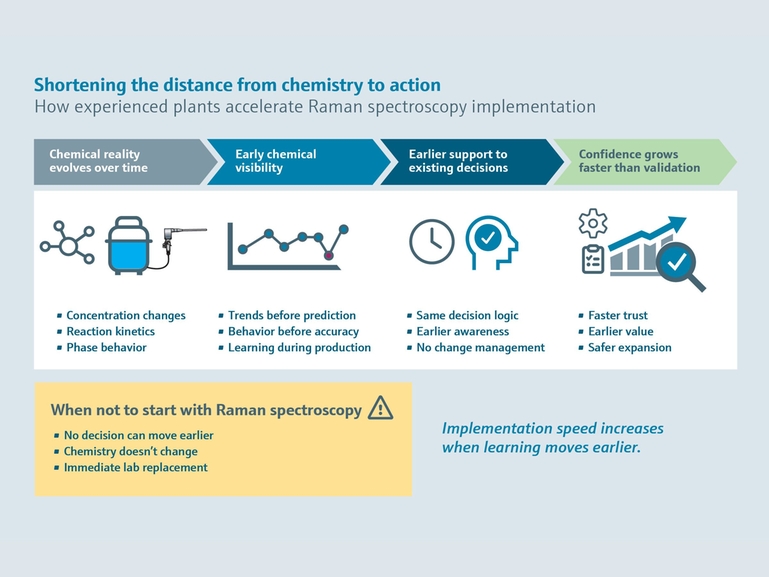
illustration of decision making with Raman insight ©Endress+Hauser
illustration of decision making with Raman insight
Introduction

Making better operational decisions with earlier chemical insight

Across chemical and polymer manufacturing, teams tend to raise similar operational questions when exploring new sources of chemical insight:

  • Would earlier visibility into chemistry materially change today’s decisions?
  • At what point can such information be considered reliable enough to act on?
  • How can it be introduced without increasing complexity or operational risk?

The framework discussed here reflects on how these questions are addressed in practice by organizations that have already navigated them. It brings together a value‑oriented, operations‑focused perspective on how Raman spectroscopy contributes when decision needs, timing, and context are aligned.

This framework also outlines a structured way to approach Raman spectroscopy in operations, organized around four recurring decision situations. Each highlights a different dimension of operational value, depending on which questions are most pressing at a given point in time.

Cover image of Raman decision-grade brief ©Endress+Hauser
Cover image of Raman decision-grade brief
Insight

When is Raman spectroscopy information solid enough to rely on?

The underlying issue

In many plants, the hesitation around Raman spectroscopy is not technical accuracy, but responsibility. Acting on inline chemical information often means committing earlier, before all traditional confirmations are available.

The real question becomes one of trust: At what point does Raman spectroscopy information deserve the same weight as other established process signals?

What this perspective brings

This first situation focuses on how experienced teams define trustworthiness in practice. It looks at Raman spectroscopy not as a replacement for laboratory analysis, but as a complementary source of insight that becomes credible through use, context, and consistency.

This is relevant if…

  • Raman data exists but is rarely used to guide actions
  • Laboratory results are still the primary reference for decisions
  • Teams are concerned about acting prematurely on inline signals

Going deeper

Our brief on decision-grade confidence explores how plants distinguish between “interesting data” and decision-relevant information, and how trust is built without increasing operational risk.

Cover image of the Raman earlier decision brief ©Endress+Hauser

What becomes possible when chemistry is visible sooner?

The underlying issue

Many operational decisions are correct — but late. By the time deviations are confirmed, options are limited, and resources have already been committed.

Earlier chemical insight from Raman spectroscopy does not change what decisions are made, but when they can be made.

What this perspective brings

This situation looks at how earlier visibility into chemistry affects everyday decisions in polymerization, grade transitions, development, and scale‑up. The emphasis is not on control strategies, but on preserving options while they still exist.

This is relevant if…

  • Issues are often detected after trajectories are fixed
  • Processes are difficult to reproduce consistently
  • Transitions or changeovers carry avoidable risk

Going deeper

Our brief on earlier decision confidence in polymerization with Raman spectroscopy examines where earlier insight has the greatest impact, and why acting sooner often leads to less intervention, not more.

Cover image of Raman accelerated implementation brief ©Endress+Hauser
Action

Why some implementations move faster than others

The underlying issue

Even when Raman spectroscopy is clearly valuable, progress can slow dramatically after initial success. This rarely stems from signal quality, but from how learning, validation, and alignment are approached.

What this perspective brings

This situation focuses on how experienced plants reduce friction between insight and action. Rather than aiming for completeness upfront, teams validate progressively and connect Raman technology to existing decision routines.

This is relevant if…

  • Raman spectroscopy projects take longer than expected to deliver value
  • Validation requirements keep expanding
  • Alignment across teams becomes a bottleneck

Going deeper

Our brief on accelerating Raman spectroscopy implementation describes practical patterns that help teams move from first signal to operational relevance without over-engineering the process.

Cover image of Raman self-qualification brief ©Endress+Hauser
Cover image of Raman self-qualification brief
Measurable value

Is Raman spectroscopy likely to make a difference in my process?

The underlying issue

Not every process benefits equally from Raman spectroscopy. Starting in the wrong context can undermine confidence, even when the technology itself is sound.

What this perspective brings

This final situation provides a way to reflect on decision readiness rather than technical feasibility alone. It mirrors how experienced plants decide whether Raman technology will meaningfully expand their operational options.

This is relevant if…

  • You want a quick, honest reality check
  • It is unclear whether earlier insight would change decisions
  • There is a desire to avoid over-scoping the first use case

Raman spectroscopy self-assessment

A checklist is available to help teams reflect on these questions and interpret what different outcomes imply — including when it may be better not to start yet.

Our expertise

Why Endress+Hauser?

Endress+Hauser supports chemical and polymer manufacturers across the full decision spectrum, not just at the point of technology selection. Our role typically starts upstream — helping teams assess whether earlier chemical insight would actually improve their process decisions — and continues through implementation, validation, and operational use. This approach includes clarifying where Raman spectroscopy is the right tool, where it may not be, and how it can be integrated into existing decision routines without adding unnecessary complexity. Drawing on application experience across polymers, fine chemicals, and specialty processes, we help identify value-relevant use cases, anticipate common implementation bottlenecks, and translate analytical insight into robust, repeatable operational practice.

Portfolio highlights

Explore our Raman spectroscopy systems

/
FAQ

Everything you need to know

Next steps

Next steps

Discuss your process challenges with our chemical industry experts. We are here to support you.

尾注

Might also interest you