Optimizing quality control in food production
Ensuring a safe, consistent and efficient manufacturing
简述
- Quality control is a strategic pillar, not just a compliance task to ensure food safety, protect brand reputation and improve operational efficiency throughout production.
- A three‑stage quality control loop from raw material inspection, in‑process control to final product testing forms the foundation for preventing contamination, stabilizing processes and achieving consistent product quality.
- Digitalization, automation and AI are transforming quality control, enabling predictive quality, connected processes and continuous improvement across the production chain.
Why is quality control important?
Quality control (QC) is the backbone of any food and beverage production. It ensures that every product meets stringent safety and quality standards before reaching consumers. In an industry where brand reputation and consumer trust are paramount, quality control is not just a regulatory requirement - it’s a strategic advantage.
A poor quality control leads to:
- Product recalls that damage brand credibility
- Health risks for consumers, resulting in legal and financial consequences
- Operational inefficiencies, such as wasted raw materials and increased production costs
What are the three stages of quality control?
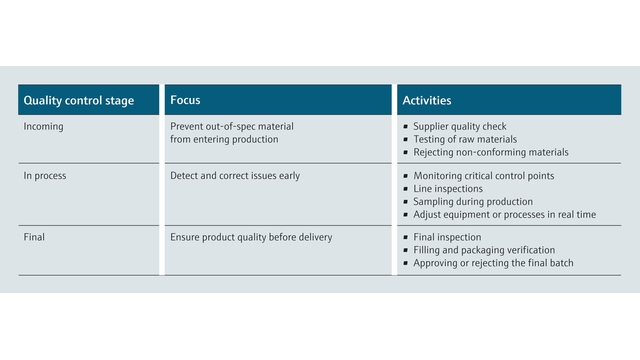
Quality control comprises three interlinked stages that together ensure product safety and process stability. During raw material inspection (incoming), the quality, purity and conformity of all incoming ingredients are checked before processing to prevent contamination and fluctuations. In-process control monitors critical parameters such as pH, viscosity or conductivity in real time to detect deviations early and stabilize the process through timely corrective measures. In addition to reducing waste, this also enables improved process control for higher efficiency and a potential reduction in energy and resource consumption. Final product testing confirms that finished products meet all specifications for safety, composition and sensory quality before they are released. Together, these three stages form a closed quality control loop that prevents contamination, verifies process accuracy and confirms that finished products meet all safety and regulatory standards. A robust framework that protects consumers and builds confidence in every batch produced.
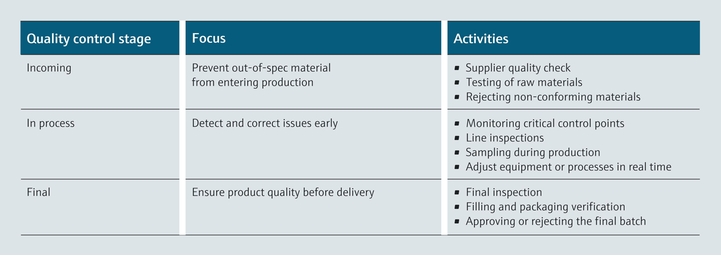
Overview of the three phases of quality control, supplemented by the corresponding focus areas and activities.
What are the methods of quality control?
Quality control methods differ in terms of speed, automation, accuracy and degree of integration into production. Inline, online, at-line and offline approaches each fulfill a specific function - from real-time monitoring to high-precision laboratory analysis - allowing manufacturers to strike a balance between efficiency and accuracy depending on their process requirements.
This overview shows how each method contributes to a comprehensive and effective QC strategy.
Comparison of inline, online, at-line and offline quality control methods showing the differences in speed, automation, accuracy, integration level and uses cases across production.
Key drivers and benefits for continuous quality control
Key drivers for quality control
- Food Safety & Compliance: Ensuring products meet strict food‑safety standards (HACCP, FSMA, EU food law) is the top driver. QC prevents contamination, safeguards consumer health, and avoids recalls.
- Brand protection and customer trust: Consistent quality protects brand reputation in a highly competitive market. One deviation can lead to lost trust and long‑term financial impact.
- Operational efficiency and cost reduction: Early detection of deviations reduces waste, rework and downtime. Inline measurement technologies enable real-time monitoring, reducing bottlenecks and accelerating batch release.
- Product consistency: Consumers expect identical taste, texture, and appearance every time. QC ensures batch‑to‑batch uniformity across global production sites
- Traceability and transparency: Supply chains require full visibility from raw materials to finished goods. QC supports traceability systems needed for audits and certifications.
- Innovation and continuous improvement: As food and beverage production moves toward automation, digitalization and clean‑label trends, QC enables better process understanding and faster development cycles.
Benefits of continuous quality control
- Faster product release and improved plant availability
- Reduced reliance on manual sampling and laboratory analysis
- Enhanced consumer trust through consistent product quality
- Lower operational costs and improved resource efficiency
Risk management and regulatory foundation of quality control
Risk management
Quality control is integral to risk management strategies, including contamination detection and resource conservation. It supports sustainability goals by reducing energy consumption and raw material waste.
Examples for quality‑related risks:
- Pathogen risk such as Listeria, Salmonella
- Allergen cross-contamination
- Foreign bodies
- Recipe variability
Regulatory foundation of quality control
Quality control in food production is grounded in globally recognized safety standards that help ensure products are consistently safe and reliable. Frameworks such as HACCP principles, Codex Alimentarius, EU 2073/2005 microbiological criteria, FSMA Preventive Controls, and certifications like ISO 22000 or FSSC 22000 provide a clear foundation for how food safety should be managed. Mentioning these benchmarks up front quickly signals credibility and shows that quality efforts are aligned with the regulation’s consumers and brands depend on.
Shaping the future of quality: Digitalization, automation and AI
The food and beverage manufacturing industry is rapidly advancing towards real‑time quality assurance, digital twins and fully connected processes that drive continuous optimization. As monitoring becomes increasingly data‑driven, IoT‑enabled devices and advanced analytics pave the way for predictive quality control, allowing trends to be identified long before defects occur. At the same time, smart manufacturing solutions are integrating quality data directly into process control systems, enabling predictive maintenance and statistical process control rooted in Six Sigma principles - an approach that prioritizes defect prevention over detection and relies on robust Root Cause Analysis as its analytical backbone. Together, digitalization, automation and AI are transforming how manufacturer optimize recipes, reduce variability and enhance sustainability across the entire production chain.
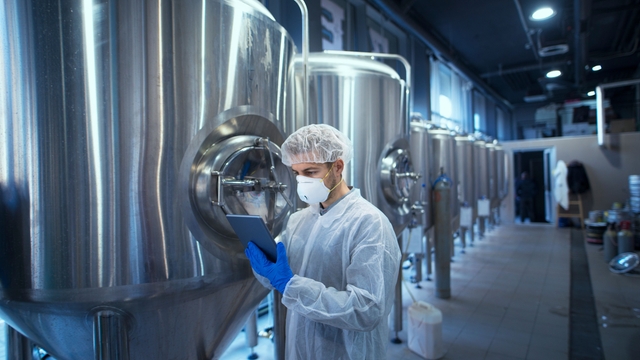
Routine inspection via a tablet to monitor the process progress or production performance.
Discuss your challenges with our experts
Our local Endress+Hauser experts are ready to support you.
Key parameters for monitoring quality
Quality control in food production relies on monitoring a set of essential parameters that ensure product safety, consistency and compliance throughout the entire process. Core measurable attributes include pH, moisture, viscosity, colour, turbidity, conductivity, concentration, dissolved oxygen and density, all of which play a critical role in maintaining taste, texture, stability and microbial safety. These parameters are monitored analytical methods to maintain uniformity across batches and to validate that raw materials, processing steps and finished products meet strict quality specifications. Ensuring accurate, real‑time measurement of these variables helps producers reduce variability, prevent contamination, and consistently deliver high‑quality, safe food products to consumers.