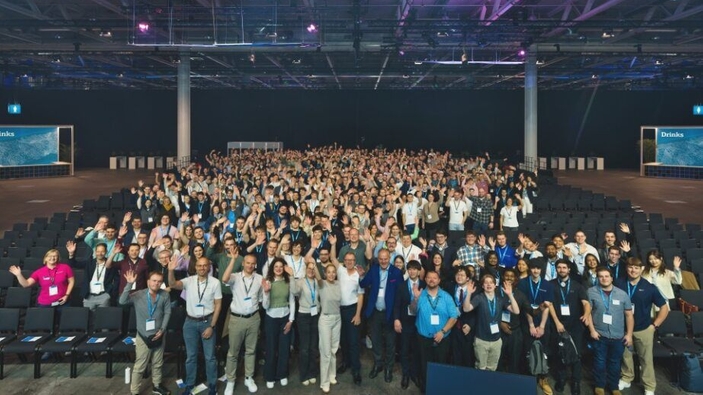
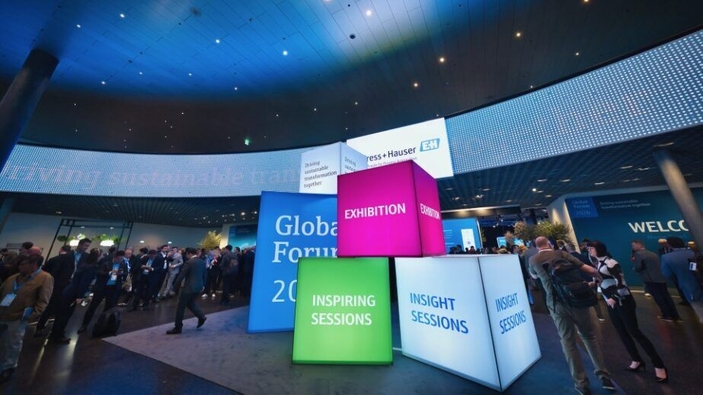
Economies and working environments around the world are changing. The process industry, too, is undergoing profound transformation. Technological leaps, demographic shifts and climate change are just a few of the forces that decision-makers are having to deal with. “We either change or change happens to us,” says British futurist Nikolas Badminton. He was one of five renowned thought leaders who spoke at Endress+Hauser’s Global Forum 2026 in Basel. In Inspiring Sessions, they offered ideas and strategies on how companies can navigate upheavals or even turn them to their advantage. Beyond the stage, the speakers also took time to share their perspectives in interviews.
The key takeaways from the 2026 Inspiring Sessions – and the five speakers in video interviews:
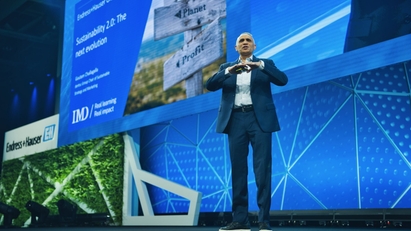
Goutam Challagalla, Professor of Strategy and Marketing at IMD Business School
Sustainability and profitability are not mutually exclusive – quite the contrary. Sustainable products can be extremely successful, says Goutam Challagalla, Professor of Strategy and Marketing at IMD Business School. This is especially true when the sustainable product also delivers traditional customer value, such as improved performance or lower prices because it is manufactured using fewer materials. This not only conserves resources but also reduces costs – a win-win.
Nikolas Badminton, Futurist
How can we get a glimpse of the future? British futurist Nikolas Badminton advises embracing a culture of imagination and regularly asking “What if…?”: What if CEOs have to “lead” AI as well as people? What if China becomes the world’s leading economic power? What if eight out of ten global megacities emerge in sub-Saharan Africa because that region has the world’s highest population growth? The future strategist focuses primarily on the circular economy and its vast potential: “The circular economy is actually good for the economy as a whole,” says Badminton. For him, the path to this is so inevitable that “I don’t think we’re going to be talking about the circular economy in 20 years. We’re just going to be talking about the economy.”
Jennifer Zhu Scott, AI investor and entrepreneur
AI investor and entrepreneur Jennifer Zhu Scott highlights the rapid pace of development in artificial intelligence. Never before has it been so easy to develop, combine and implement AI applications. A single person can bring entire business models to life – from concept to implementation – quickly, cost-effectively and with a high degree of automation. Human experiential knowledge can be stored and shared like a “second brain,” which could fundamentally transform the economy and society. At the same time, the major challenges facing the AI economy must be addressed: computing power, energy requirements and, linked to these, sustainable solutions. However, Jennifer Zhu Scott considers AGI (artificial general intelligence) – that is, AI capable of thinking, learning and applying knowledge with a flexibility similar to that of humans – to be a “human-centric fantasy,” because, in her view, “what we are about to discover is that human intelligence is one of the types of intelligence.”
Dr Katharina Hermann, Human resources expert
Human resources expert Dr Katharina Hermann describes the current era as the “most profound transformation of the global workforce in modern history.” Demographic shifts, technological leaps and pressure to increase productivity are fundamentally changing corporate workforces. In the near future, these workforces are likely to become significantly more diverse in terms of origin, age and personal backgrounds. “The companies that will lead the way in the coming decade are those that invest in reskilling, inclusion and leadership,” says Hermann, who served on the executive board of Hubert Burda Media until 2025.
Jonathan Brill, Futurist
For futurist Jonathan Brill, disruptive times always bring one thing with them: opportunities. Using numerous examples, he shows how companies have grown during crises or created new markets through fresh thinking. The key, he argues, is not to try to foresee every scenario, but to consider what the direct consequence of a crisis or upheaval is – in other words, what might be the next development. Or, as he puts it, “What’s the second domino?” This approach works because many disruptions have very similar consequences – such as interruptions in supply chains. Strategic innovation here creates the necessary flexibility to realign one’s own business.