Biodiesel control: How to increase yield in transesterification
Effective biodiesel process control improves transesterification yield by minimizing variability, losses and off‑spec production.
简述
- Transesterification is the most critical step in biodiesel production and is highly sensitive to feedstock quality, stoichiometry and operating conditions.
- Small deviations in reaction, separation or washing stages can reduce conversion efficiency, increase methanol losses and destabilize continuous biodiesel production.
- Reliable, real‑time measurement of key variables enables tighter biodiesel process control, helping producers maintain high biodiesel yields.
Biodiesel process control for a growing low-carbon market
关键点
+ 41 billion
increase in global biodiesel demand by 2026
Growth driven by decarbonization and energy‑security targets
Biodiesel is a renewable fuel derived from the transesterification of vegetable oils, such as soybean, cottonseed, canola and palm oil, or from animal fats. It can be utilized in modern diesel engines either as pure fuel (B100) or blended with petroleum diesel. As regulatory pressure intensifies, biodiesel has become an essential component of low‑carbon fuel strategies worldwide.
In Brazil, one of the world’s largest biodiesel markets, the National Energy Policy Council (CNPE) has mandated a gradual increase of the biodiesel blend to 15% by 2026, reinforcing global momentum toward bio‑based fuels.
The European Union sets binding targets for the transport sector, including maritime and aviation. By 2030, EU member states must reach 29% renewable energy in transport or achieve a 14.5% reduction in greenhouse gas intensity, with an additional 5.5% sub‑target for advanced biofuels and renewable hydrogen.
While transport remains the biggest biodiesel consumer, recent U.S. State Energy Data System (SEDS) reports show that more residential, commercial and power‑sector users are adopting it as well. Global demand is projected to grow by over 41 billion liters between 2021 and 2026, driven by decarbonization initiatives, energy‑security requirements and the need to reduce reliance on fossil fuels.
Rising demand translates into pressure on biodiesel producers to optimize biodiesel fuel yield, improve process stability and ensure consistent fuel quality. The transesterification step is especially sensitive and requires tight control to remain stable.
Optimizing transesterification for higher biodiesel yield
Biodiesel is produced from natural oils or fats through a multi‑stage industrial process:
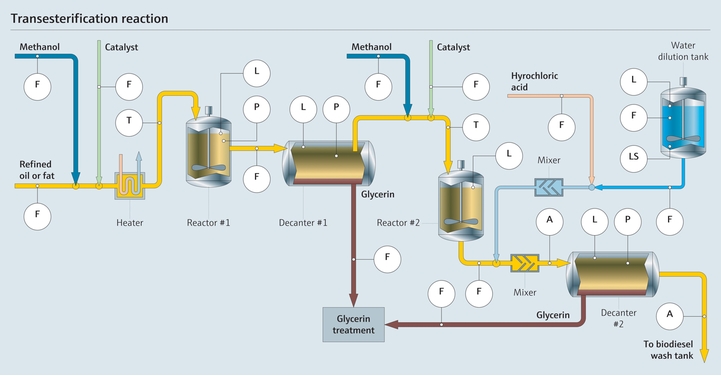
- Raw material preparation: First, the raw material is heated and mixed with methanol and a catalyst
- Reaction stage: The mixture is then fed into one or more stirred reactors, where the main chemical conversion takes place
- Transesterification reaction: During transesterification, triglycerides from oils or fats react with methanol in the presence of a catalyst, producing fatty acid methyl esters (FAME) and glycerin as a by‑product
- Phase separation: Following this stage, decanters or settlers separate biodiesel from glycerin
- Purification and finishing: The biodiesel is washed and purified to remove any remaining catalyst, methanol, and soap residues before being polished and stored. Efficient separation ensures that glycerin is fully removed from the biodiesel phase
Effective biodiesel process control at each stage is essential for reliable operation and high biodiesel yield. Stable operating conditions improve conversion, support consistent separation performance, and preserve fuel quality.
Detecting and preventing instability in biodiesel production
Subtle deviations can affect continuous biodiesel production. The signs may show up even when the unit operates within its design limits. Common indicators include lower yield, poor phase separation and inconsistent purification. Such instabilities usually reveal gaps in biodiesel process control, potentially leading to off-spec products or complete batch failures.
Typical signs of process variability include:
- Lower than expected triglyceride conversion in Reactor #1 (~90%), often indicating an incorrect methanol to oil ratio or insufficient mixing
- Inconsistent total conversion after Reactor #2 (target >97.5%), leading to variable batch quality
- Soap formation, emulsions or slow glycerin separation, usually caused by water ingress, catalyst imbalance or reaction drift
- Fluctuating washing performance, resulting in unpredictable final biodiesel quality and inconsistent FAME purity
- Rising methanol consumption or reduced methanol recovery efficiency
Early symptoms may be visible to operators, but they usually point to deeper reaction-level issues hidden in day-to-day processes. Understanding the root causes is essential for maintaining transesterification stability and preventing recurring quality deviations.
Causes of variability in transesterification reactions:
- Stoichiometric drift from inaccurate control of the oil‑to‑methanol ratio, leading to lower conversion efficiency and increased methanol losses
- Fluctuating reaction conditions: temperature, pressure, residence time or mixing intensity, which prevent the conversion from proceeding consistently and reduce its efficiency by several percentage points, directly impacting yield and methanol consumption
- Inefficient glycerin removal in early stages, reducing the driving force for methyl ester formation and reducing overall conversion
- pH instability during neutralization or washing, which promotes soap formation, emulsions, and in severe cases, corrosion effects in downstream equipment
- Limited ability of downstream units to compensate for upstream variation, causing quality swings, longer processing times and higher operational effort
Preventing instability takes more than routine operation. Real-time visibility into the process is essential to detect deviations and take corrective action before conversion efficiency, yield or fuel quality are affected.
Real-time monitoring helps maintain the process within its narrow operational window. It also supports continuous biodiesel production, ensuring consistent yield and fuel quality in every batch.
Key measurement points for reliable biodiesel process quality control
Effective biodiesel control begins with knowing which measurement points matter most. A few core variables shape reaction, separation and purification performance. Tracking these core variables makes the process far easier to stabilize.
Feed control
- Mass flow measurement of oil, methanol and catalyst ensures accurate reactant dosing and maintains the correct stoichiometric ratio for stable biodiesel conversion
- Feed preheat temperature monitoring ensures reactants enter the reactor within the required thermal window for consistent reaction kinetics
Reaction control
- Feed or circulation flow measurement maintains stable dosing, mixing quality and consistent residence time in the reaction system
- Pressure monitoring in the reactor and transfer lines detects restrictions, gas formation, fouling or unstable reaction conditions
- Temperature monitoring stabilizes reaction kinetics and helps identify heat transfer limitations or reduced catalyst activity
- Level monitoring maintains stable residence time and prevents overfilling or short-circuiting of the reaction volume
Separation control
- Level and interface monitoring tracks the phase boundary in the decanter or settler and detects emulsion layers or unstable settling behavior
- Density measurement of biodiesel or mixed phases reveals conversion trends and detects methanol contamination, water carryover or glycerin presence
- Temperature monitoring stabilizes viscosity conditions and improves phase separation efficiency
- Feed flow measurement to the decanter maintains stable residence time and consistent separation conditions
- Optical monitoring of wash water clarity or phase boundary quality detects emulsions, soaps or incomplete separation before they affect downstream washing
Purification control
- pH monitoring in neutralization and washing circuits prevents soap formation, emulsions and fouling in purification equipment
- Pressure monitoring in washing or purification columns indicates column loading, fouling or unstable washing performance
- Temperature monitoring during washing and drying supports efficient moisture removal, methanol stripping and stable washing conditions
- Conductivity or optical monitoring of wash water purity detects contamination, carryover or insufficient washing that can affect final biodiesel quality
Reliable measurement turns a sensitive transesterification sequence into a process that can be consistently steered and stabilized. When operators can trust the signals, they can correct small shifts before they escalate into lost yield or downstream variability. This directly shapes the overall impact on continuous biodiesel production.
With a comprehensive portfolio covering flow, level, pressure, temperature, density and analytical measurements, Endress+Hauser enables full visibility across the biodiesel process from feedstock dosing to final product quality.
The impact of instrumentation on biodiesel control
Robust instrumentation with continuous self-diagnostics provides the baseline operators need to run transesterification with confidence. When process signals are accurate, operators can make proactive adjustments, ensuring that conversion, separation and purification processes run smoothly. It provides real-time visibility to prevent deviations and ensure consistent batch quality.
Reliable measurement data supports:
- Higher biodiesel yield and conversion efficiency, increasing production output per batch
- More predictable product quality, reducing off-spec batches, rework and downstream variability
- Lower operating cost per liter through reduced methanol loss, better energy use and fewer reprocessing steps
- Lower downstream processing effort thanks to improved phase separation and fewer emulsions entering washing and drying
- Improved environmental performance driven by reduced chemical consumption, lower wastewater generation and better methanol recovery
- Reduced chemical consumption and wastewater generation due to stable neutralization and washing behavior
- A stronger safety and compliance profile supported by reliable visibility into key variables that influence regulatory audits and reporting accuracy
Key questions in biodiesel process control
This section addresses common questions related to transesterification stability and biodiesel yield. It focuses on typical operational challenges such as phase separation issues, stoichiometric imbalance and process variability.