Biochemicals & circular economy: Optimizing the bio‑value chain
Transitioning from fossil-based to renewable feedstocks introduces process variability. Explore what causes production drift in bio-based processing and what’s required to sustain high‑purity yields at scale.
简述
- The biochemical market is growing rapidly, driven by decarbonization targets, regulatory pressure and increasing demand for circular production.
- Biochemicals enable circular production by converting renewable feedstocks into versatile intermediates used across multiple value chains.
- Key end products include biofuels such as biodiesel and bioethanol, as well as bio‑based materials like polylactic acid (PLA).
- Scaling biochemical production requires controlling variability across feedstocks, processes and downstream operations.
Biochemicals driving biofuels and renewable chemical production
Key drivers of market expansion
Biochemicals are emerging as key building blocks of the circular economy, derived from renewable feedstocks such as biomass, organic residues and waste streams. They enable the shift from fossil-based to bio-based chemistry across fuels, materials and specialty chemicals. Acting as platform molecules, biochemicals range from fatty acids, amino acids and nucleic acids to complex and very large molecules used to produce fuels, polymers and specialty chemicals.
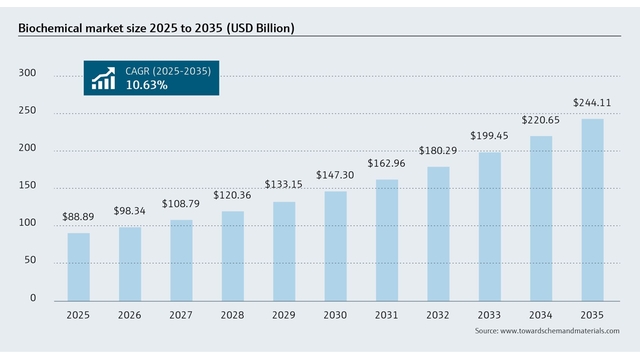
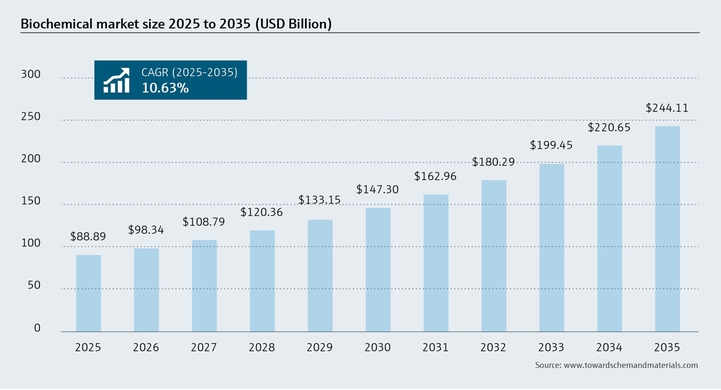
The urgency to optimize the bio‑value chain is driven by both scale and impact. The global biochemical market was valued at around $88-90B USD in 2025 and is projected to more than double by 2035, with annual growth rates of 7-10%.
According to the International Energy Agency (IEA), chemical manufacturing accounts for around 935 million tonnes of direct CO₂ each year. This makes it one of the most challenging sectors to decarbonize. Without wider adoption of biochemicals and other climate-friendly alternatives, emissions from the chemical and petrochemical industry could reach nearly 2.8 billion tonnes of CO₂ equivalent by 2030, representing an increase of almost 50% compared to 2010 under a business‑as‑usual scenario.
关键点
Biochemicals are part of the solution. Life cycle assessments show that bio-based products can cut greenhouse-gas footprints by around 45% compared with fossil-based alternatives. Results vary depending on feedstock, process configuration and scale. This positions biochemicals as a central driver for reducing the carbon footprint of chemical production while advancing circular models.
Regulatory pressure accelerating the transition
Global policy frameworks are actively reinforcing this shift. In Asia, climate ambitions are increasingly aligned with industrial decarbonization and resource efficiency. China targets carbon neutrality before 2060 , while Japan and South Korea aim for 2050. National strategies support these goals through bio-based materials, advanced biofuels and circular manufacturing to reduce reliance on fossil feedstocks.
In Latin America, Brazil’s RenovaBio program establishes national decarbonization targets for the fuel sector. It certifies biofuels based on life-cycle greenhouse-gas performance, issuing tradable decarbonization credits (CBIOs) linked to verified emissions reductions.
In the United States, the Inflation Reduction Act supports biofuels by offering tax credits to producers whose fuels achieve low life-cycle greenhouse-gas emissions.
In the European Union, the Renewable Energy Directive (RED III) sets a binding target of at least 42.5% renewable energy by 2030, with a strong focus on transport fuels, industry and advanced bio based pathways. Member States must either achieve 29% renewable energy in transport or a 14.5% reduction in greenhouse gas intensity, directly influencing biofuels, renewable chemicals and biochemical supply chains. These requirements are further reinforced by sustainability criteria, certification systems and life-cycle reporting obligations that ensure verified carbon reductions across value chains.
Integrating biochemicals into a circular economy
Renewable building blocks serve as core intermediates for a wide range of bio-based products that are already established in global energy and materials markets. They enable the conversion of renewable feedstocks into end products with different performance profiles depending on process routes and application requirements. This forms the structural foundation of a circular bio-value chain.
Carbon circulation in chemical systems
As chemical manufacturing accounts for roughly 10% of global industrial CO₂ emissions , bio‑based economy transitions increasingly focus on how renewable materials are integrated into production systems. Bio‑based processes retain carbon within industrial value chains by using biological resources rather than relying on continuous fossil inputs.
Biochemicals play a central role in this development by linking renewable raw materials to a wide range of downstream fuels and intermediates, supporting more resilient and climate‑aligned production.
Closing carbon loops through bio-based production
In bio‑based production, renewable feedstocks are converted into intermediates that can serve multiple end products instead of being used only once. This approach helps close carbon loops by keeping materials in circulation across successive process steps and applications. Connecting these stages improves overall process efficiency and supports lower life cycle emissions.
In practice, this is achieved by linking fermentation, targeted chemical conversion and downstream processing. Fermentation transforms biomass or organic residues into intermediates, chemical steps adapt them for specific applications and downstream operations isolate and purify the final products. Integrating these stages enables more efficient use of resources while further reducing environmental footprint.
Waste-to-value and resource efficiency
Biochemicals enable the productive use of residual and waste streams within chemical value chains. However, converting agricultural residues or organic waste into valuable inputs introduces significant operational complexity. Managing the feedstock variability of these streams is essential to maintain process efficiency and avoid yield losses.
Residual streams can vary widely in composition. Careful control and precise processing help convert these streams into high‑purity industrial outputs.
Platform molecules and market flexibility
Platform molecules allow manufacturers to produce different end products from the same biochemical process. A single intermediate such as succinic acid or fatty acids can be directed into fuels, solvents or polymers, depending on current market needs.
This flexibility lets companies adjust output without changing core processing steps. Production can shift between high‑volume fuels and higher‑value specialty chemicals using the same assets. As a result, manufacturing is less dependent on a single end market and better able to respond to changing demand.
Measuring impact with life-cycle assessment
Environmental performance in biochemical production cannot be evaluated through isolated process improvements alone. Life-cycle assessment (LCA) provides a structured way to quantify emissions, energy use and resource consumption across the entire value chain, from feedstock sourcing to final production.
By covering the entire value chain, LCA helps identify where impacts occur and compare bio‑based and fossil‑based pathways on a consistent basis. When applied across the full bio value chain, LCA supports informed decision‑making, regulatory compliance and sustainability reporting for biochemical production.
Key bio-based products derived from biochemicals
Biodiesel as a renewable transport fuel
Biodiesel is produced from biochemicals derived from vegetable oils, waste oils, animal fats and residual streams such as by-products from the wood industry or oleochemical processes. It can be used in conventional diesel engines either as a standalone fuel or as a blend with fossil diesel. Biodiesel production typically relies on transesterification reactions that convert fats and oils rich in fatty acids into usable fuel components.
As a renewable transport fuel, biodiesel contributes to reducing life-cycle greenhouse-gas emissions and supports regulatory frameworks focused on lowering carbon intensity in the transport sector.
Bioethanol for low-emission fuel blending
Bioethanol is produced through the fermentation of sugar, starch or lignocellulosic feedstocks. It is widely used as a blending component in gasoline across many national fuel systems. By substituting part of the fossil fuel content, bioethanol helps reduce overall emissions from road transport and improves the renewable share of liquid fuel consumption.
Polylactic acid (PLA) in bio‑based polymer manufacturing
Polylactic acid (PLA) is a bio-based polymer derived from renewable feedstocks such as corn starch or sugarcane. It is produced via biochemical intermediates generated during fermentation and subsequent processing.
PLA end-use applications include:
- Packaging
- Textiles/fibers
- Consumer goods
- 3D printing filaments
- Selected industrial applications
Industrial processing and control of biochemicals
While biochemicals support lower-carbon fuels and materials, their environmental and economic performance depends on efficient large-scale production. Converting renewable feedstocks into high-purity products requires stable processing across multiple stages, including feedstock preparation, biochemical or catalytic conversion and downstream purification.
Process stability and operating conditions
As production scales, small fluctuations in feedstock characteristics or process parameters can reduce conversion efficiency and affect product quality. Precise control of temperature, pH and nutrient balance is therefore critical for reliable large-scale operation.
The role of measurement and control systems
Bioreactor instrumentation and in‑line analytical technologies provide real‑time process data to monitor biochemical reactions, detect deviations at an early stage and adjust operating conditions accordingly. Continuous visibility into process behaviour helps reduce variability, improve conversion efficiency and support stable large‑scale production.
From biochemicals process control to business performance
Effective process control can reduce raw material losses, lower energy demand and minimize off-spec production while supporting regulatory compliance and sustainability targets. Reliable measurement and control systems therefore play an important role in scaling biochemical production efficiently and enabling more resilient circular manufacturing models.
Key questions on biochemicals in circular manufacturing
Transitioning to circular manufacturing raises important questions about how renewable feedstocks behave in industrial production systems. The following answers address common challenges related to process stability, feedstock variability and large-scale biochemical production.