尝试输入关键词、订货号/产品型号或序列号(“CM442”或“技术资料”)进行查找
至少输入2个字符开始搜索。

Accelerating transformation

Water is a vital resource, yet it is increasingly scarce in many places. Anne Le Guennec, CEO of Veolia’s global water technologies activities, explains why ecological transformation cannot be delayed any longer.

11.05.2026 文字: Questions Christoph Stockburger 摄影: Christoph Fein
Water is a vital resource, yet it is increasingly scarce in many places.

Ms Le Guennec, Veolia’s water technologies provide global solutions for sustainable water treatment. How has your profession changed your perspective on this everyday resource?

Having studied engineering and contributed to the design of water treatment plants very early in my career, I was already fully aware of how complex the supply of this resource is. That’s why, when I turn on my faucet, I no longer see just water: I see a whole spectrum of technologies, the expertise of my colleagues, the chemistry, the data and the immense engineering required to ensure safety. I also think about the equipment working in the background and the teams monitoring the flow even through the small hours of the night – ensuring that whenever someone, somewhere, turns on a faucet, water comes out just like they would expect. My perspective shifted long ago from “What can this water do for me?” to “How do we ensure that the water supply continues to work for everyone?”

What are currently the biggest challenges for sustainable water management?

To protect public health and keep the wheels of industry turning, we must stop thinking of water as a single-use resource. At Veolia, we’re tackling this by scaling up reuse. Every industry must be able to reuse its water to the fullest extent possible in order to guarantee its independence and performance, reduce its environmental footprint, and maybe even redistribute this water to third parties. There is also the possibility of converting wastewater into an energy source for companies’ own consumption or that of others. However, volume is only half the battle; safety is the other. We are seeing a massive rise in micropollutants and PFAS – substances that are omnipresent in our daily lives.

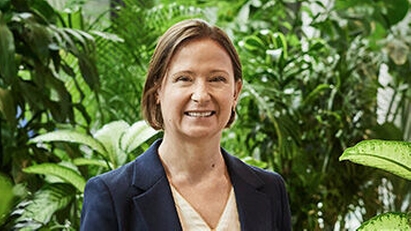
Anne Le Guennec, CEO of Veolia Water Technologies.

“The cost of inaction would be higher than the cost of action.”

Anne Le Guennec, CEO of Veolia Water Technologies.

Sustainability Strategist

Anne Le Guennec (born in 1975) is CEO of Veolia’s global water technologies activities and a member of Veolia Group’s Executive Committee under CEO Estelle Brachlianoff. She joined Veolia in 1998, after graduating from the Compiègne University of Technology. Le Guennec has held leadership roles across services for waste, water and energy in Europe, the Middle East and North Africa. With more than 20 years of experience in operational management, business development and innovation, she has led Veolia’s global water technology activities since 2023. Under her leadership, the company advances strategic priorities such as the GreenUp program. In her spare time she enjoys photography, running, golf and reading. Among her favorite books are Shibumi by Trevanian and Wellness by Nathan Hill.

How does Veolia help to address these challenges?

Our strength lies in the breadth of our portfolio, our 170 years of expertise and our global presence. Together they allow us to adapt global best practices to local challenges. Also significant is our ‘loop’ approach to safety. If I take the example of PFAS, Veolia is one of the very few who can destroy them. Our portfolio of end-to-end solutions spans sampling and analysis to responsible waste treatment. Based on our expertise, we launched our strategic GreenUp program in 2024. With the program we want to accelerate the deployment of existing solutions and drive innovation to help our customers save 1.5 billion cubic meters of water and offset 18 million tonnes of CO₂ by 2027.

Where do you see the greatest potential?

The most promise lies in plants that can harmonize their water and energy management. We need energy to treat water, and conversely water is essential to energy production. We have the solutions to transform wastewater sludge into energy, optimize water treatment to reduce electricity consumption and improve the energy efficiency of equipment.

Veolia is a global leader in services with businesses activities 
in water, waste and energy. ©Endress+Hauser

What’s the role of automation and measurement technology in Veolia’s sustainable water solutions?

The drinking water and wastewater treatment plants and facilities we design are required to be equipped with advanced measurement instrumentation and automation solutions to obtain accurate data for optimizing production. Endress+Hauser’s instruments reliably provide essential information to maintain operations and improve processes. Like us, Endress+Hauser has European roots while operating globally. We have many joint projects – in water, energy and waste management – in countries including the USA, France, Saudi Arabia, China, the UAE and Colombia.

How must the ecological transformation be shaped for you and your customers?

We’ve shifted from being a water company to a water science company and we innovate to reconcile the economy with ecology and social responsibility. Our more than 4,000 patents dedicated to water technologies allow us to guarantee results. Currently, for many of our customers that I speak with, water quality and water scarcity are strategic economic risks. A mayor or a plant manager might call us urgently during a drought or flood. For us, as for our customers, we implement the most concrete and cost-effective solutions to guarantee access to water and ensure service continuity. Transforming waste into energy, or wastewater into fresh supply, directly lowers costs and counters resource scarcity. Given the uncertainty that we live in, most people now recognize that the cost of inaction would be higher than the cost of action. If we can use our patented tech and engineering expertise to cut a desalination plant’s energy use by 35 percent, we aren’t just easing a burden on the environment – we’re making it affordable for a city to provide water to its people. Thus a cost turns into a viable, sustainable investment.

What leverage do digitalization and AI offer in your business?

Digitalization and AI are the ‘nervous system’ of our operations. In 2025, we further strengthened AI capabilities within our operations, enabling teams to manage water, waste and energy facilities with the support of advanced decision-making tools.

Global leader with a clear purpose

Veolia is a global leader in services with businesses activities in water, waste and energy. It helps cities and industries across more than 48 countries to develop, preserve and replenish resources. The Group has explicitly defined ecological transformation as its purpose and environmental security as its strategic objective. Established in 1853 under the name Compagnie Générale des Eaux, Veolia is headquartered in Paris, France, employs 215,000 people (2025) and generated revenue of 44.4 bn euros in 2025.

Anne Le Guennec, CEO of Veolia Water Technologies.

“The partnership between Veolia and Endress+Hauser is built on a shared understanding of precision.”

Anne Le Guennec, CEO of Veolia Water Technologies

How do you maintain your innovative edge?

We constantly analyze future market trends to proactively address our customers’ needs. Currently, for example, we are supporting the pharmaceutical and microelectronics boom by providing our customers with cutting-edge ultrapure water solutions and creating centers of excellence to inform and train them. The other half of the secret is staying humble. We know we don’t have a monopoly on good ideas, so we partner with agile startups and universities to generate fresh sparks. Collaboration is the only way we’ll meaningfully make a real impact on the ecological emergency. No single company, no matter how large, has a silver bullet for climate change.

What do partners need to bring to the table to make a collaboration a success?

We are looking for partners who share our commitment, our drive to move mountains, by contributing their expertise and innovations. Veolia has also established a new type of partnership that aims to bring together different stakeholders – researchers, academics, industry profes-sionals, funders, NGOs, startups and Veolia experts – in workshops focused on complex global issues, such as micropollutants. There they can exchange ideas, find new solutions and implement concrete actions in the short and medium terms.

Greenup strategy

GreenUp is Veolia’s strategic program to accelerate ecological transformation. Backed by billions of euros in targeted investments, it focuses on deploying practical solutions around three themes: depollution, decarbonization and resource regeneration. The company has also designated priority business areas — its ‘growth boosters’ — which it sees as the most impactful: local energy and bioenergy, water technologies and new solutions and hazardous waste treatment.

What characterizes the partnership between Veolia and Endress+Hauser?

Endress+Hauser supports Veolia across our three core businesses: water, energy and waste. Our partnership is built on a shared understanding of precision. By integrating high-precision sensors into the design of water, energy or waste treatment plants, or even directly into our own equipment, we work together to optimize our customers’ plants in real time. It’s a relationship characterized by technical trust – knowing that the data is rock solid allows us to push our innovation further and guarantee results for our customers.

The ecological transformation requires staying power. How do you stay motivated and optimistic in times of rapid change and uncertainty?

It’s easy to get overwhelmed by the climate change headlines, and yet it’s very hard to be a pessimist when you see a community experiencing water scarcity getting a new, reliable water source, or a factory managing to recycle 98 percent of its water. I stay optimistic because I witness the speed of our GreenUp plan every day. When you see that environmental security is not only possible but already happening, global uncertainty starts to look less like a threat and more like an opportunity to lead. The future belongs to those who act.

过往活动报道

资料下载

查找更多资料

document icon
公司杂志《Changes》2026年第1期 PDF, 7.5 MB
引领可持续转型
download icon 下载