


Martin Raab
Head of Public Communication and Group Media Spokesman, global

Celebrating the successful handover of the new well to Hibemandla Primary School in Lillydale, South Africa.
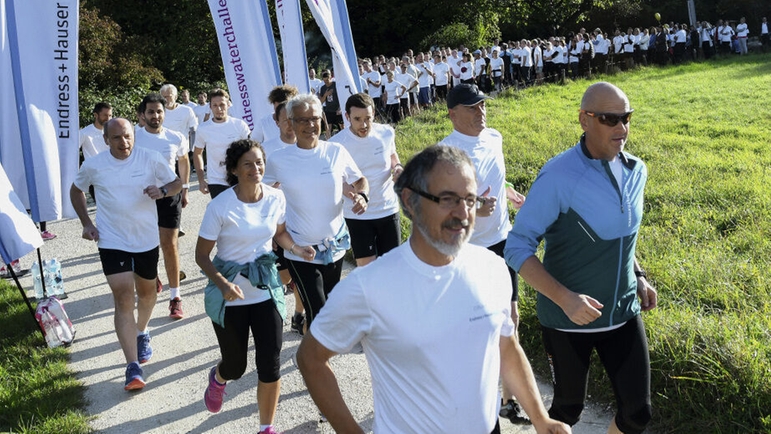
Initiated in 2019, the Endress+Hauser Water Challenge provides support for carefully selected aid projects relating to drinking water or water management.
Every year, Endress+Hauser employees take part in the Endress+Hauser Water Challenge to raise funds for a selected water project. The 2026 Water Challenge will be held on 7 May under the theme “Clean water – clear future” and will support a school complex in Togo.
For millions of people around the world, safe drinking water on tap is a distant luxury. “Roughly a quarter1 of the Earth’s population lacks reliable access to safe drinking water,” explains Endress+Hauser CEO Dr Peter Selders. “As a company, we want to help improve this situation because water is fundamental to health, education and social participation.”
In 2019, Endress+Hauser, a specialist in measurement and automation solutions for the water and wastewater industry, launched the Endress+Hauser Water Challenge – a worldwide in-house initiative to fund carefully selected aid projects related to drinking water or water management. Every year, company employees get together to go walking, running, cycling or swimming. For every kilometer covered they make a donation, which is then matched by the company.
Last year, this charity event raised a total of 12,000 Swiss francs, which was used to help provide drinking water for Hibemandla Primary School in Lillydale, on the edge of South Africa’s Kruger National Park. The school’s 560 students were struggling after two boreholes on the school campus had run dry.
Endress+Hauser used the proceeds to have a new 185-meter-deep well drilled near the school. The school community now once again has access to fresh drinking water and water for preparing meals. Endress+Hauser also built 40,000 liters of water storage capacity on the school grounds. Before that, the school could access only 10,000 liters a week – by tanker truck.
The Endress+Hauser Water Challenge 2026 is in aid of a school complex in the north of Togo’s capital city, Lomé. About 1,000 children and young people attend Complexe Scolaire Mon Devoir, which goes from kindergarten all the way up to high school. The site is located on a former marshland and regularly floods during heavy rainfall. This causes mold, damages buildings and poses considerable health risks for the school community.
Despite having its own well and a four-chamber septic tank, the school site lacks proper drainage. And while there are plans for a central wastewater system for this underprivileged area, it will be 10 to 15 years before the facility is ready. Meanwhile, short-term alternatives such as pumping and removal by tanker truck are commercially and ecologically unviable.
For these reasons, the proceeds of the 2026 Endress+Hauser Water Challenge will be used to build an infiltration pit that will channel rainwater and wastewater in a controlled manner into subsoil layers. The money will also be used to fund hydrogeological studies, technical system planning and the installation of sensor systems to monitor water levels and water quality. Any funds left over from the 2025 Endress+Hauser Water Challenge will also be put toward this project.
1 WHO and UNICEF (2025): Progress on Household Drinking Water and Sanitation 2000–2024: Special Focus on Inequalities
|
文件大小: |
5.6 MB |
|
文件名: |
EH_2026-01-22_water_challenge.zip |
Martin Raab
Head of Public Communication and Group Media Spokesman, global
