尝试输入关键词、订货号/产品型号或序列号(“CM442”或“技术资料”)进行查找
至少输入2个字符开始搜索。

IT/OT convergence: Balancing innovation, technology and cybersecurity

With IT/OT convergence in today's digital plant, security is essential – not just for innovation, but for safeguarding productivity, safety, and regulatory compliance from evolving threats. 

Image of a chemical processing plant with a glowing shield and lock illustrating cybersecurity

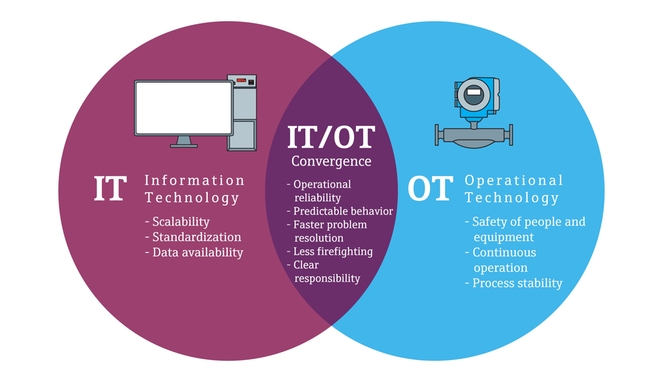
Today we are witnessing a convergence of IT and OT environments, largely being driven by digital transformation, IIoT and the rise of new technologies such as artificial intelligence and machine learning. But what does this mean for the process industries?

The convergence of IT and OT has started to blur the line between the physical and the digital space and is introducing new vulnerabilities. As a result, integrated security is no longer a nice-to-have, but rather a necessity. What were once isolated systems are now increasingly connected, often without having been originally designed to operate across clearly defined security zones and controlled data conduits. In essence, this means critical infrastructure and industrial operations can potentially be more susceptible to cyberattacks that could impact productivity, efficiency, quality, and even safety.  

What is IT/OT security? 

Traditionally, IT security focuses on protecting data and information systems, ensuring their confidentiality, integrity, and availability. This includes safeguarding computers, networks, and servers from breaches, malware, and unauthorized access, while OT security focuses on protecting the physical hardware and software that monitors, controls and measures physical processes and equipment. The primary goal of OT security is to ensure the safety and continuous availability of physical operations in the plant. 

Today, the increasing connectivity between the physical and digital space has given rise to a new concept of IT/OT security, which refers to the combined practices and technologies used to protect both the digital information systems (the IT) and physical process control systems (the OT) from cyber threats. With the introduction of digitally enabled sensors and IIoT technology, the gap between digital and physical in process industries is shrinking, and therefore, we must go beyond the physical and ensure the cybersecurity of instrumentation as well.

Importance of cybersecurity in process industries 

In the process industry, IT/OT security is no longer just about protecting data; it’s about safeguarding critical operations that keep plants running and communities safe. A single vulnerability can lead to downtime, equipment damage, environmental harm, or even risks to human lives. As connectivity expands and regulations tighten, securing IT/OT systems must become a business-critical priority. Here’s why it matters: 

The growth of Industry 4.0 and the need for real-time security risk management 

Recently, Industry 4.0 has been driving connected systems, automation, and data-focused processes. However, increased connectivity also increases exposure to cyber threats. Traditional periodic risk assessments can’t keep pace with today’s dynamic environments. Real-time security risk management enables organizations to detect, assess, and respond to threats as they happen, reducing downtime and safeguarding critical operations. 

By continuously monitoring IT and OT networks, companies gain immediate visibility into anomalies and vulnerabilities. Real-time data supports dynamic risk prioritization, ensuring resources focus on the most critical issues. Combined with automated alerts and predefined response workflows, this approach accelerates recovery and minimizes operational impact. 

The IEC 62443 series emphasizes ongoing risk management across the full lifecycle of industrial automation and control systems as a foundation for cyber-resilience. 

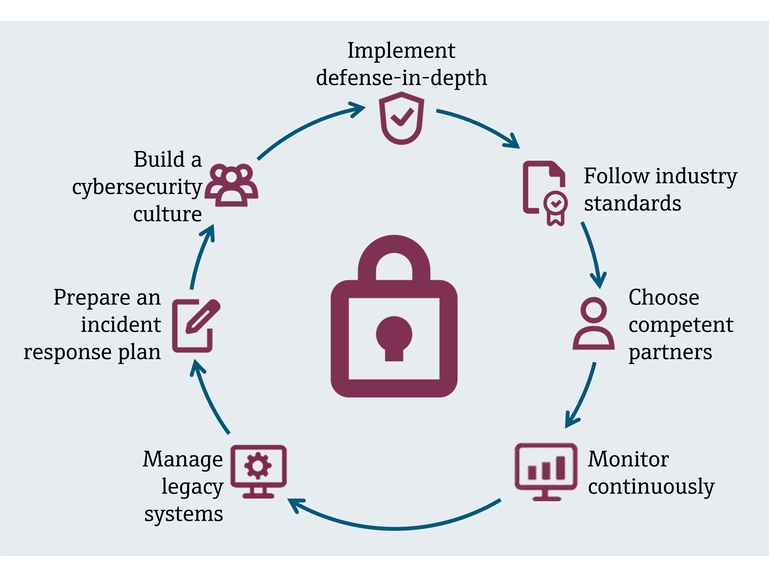
Graphic illustrating the best practices for achieving cyber resilience ©Endress+Hauser
Graphic illustrating the best practices for achieving cyber resilience

Achieving cyber resilience in the digital plant

Cyber resilience is not a one-time thing; it is an ongoing process. One that strengthens operational continuity and safeguards critical infrastructure in an increasingly connected world. By ensuring the cyber resilience of your plant, you can ensure your operations can withstand and recover from cyber incidents without compromising safety or productivity. To build cyber resilience in your plant, we suggest the following: 

  1. Implement defense-in-depth: Layer security measures across IT and OT networks; firewalls, intrusion detection, network segmentation, and strict access controls. 
  2. Follow industry standards: Adopt frameworks like IEC 62443 and NIST Cybersecurity Framework to ensure compliance and best practices. 
  3. Choose competent partners: Choose suppliers that have a certified secure development lifecycle. This ensures that components are developed secure-by-design and are managed over their whole lifecycle.  
  4. Monitor continuously: Use real-time monitoring and threat detection tools for visibility and quick response to anomalies. 
  5. Manage legacy systems: Apply compensating controls like network isolation and application whitelisting where patching isn’t possible. 
  6. Prepare an incident response plan: Define roles, escalation paths, and recovery steps, and test regularly to ensure readiness. 
  7. Build a cybersecurity culture: Train employees, promote IT/OT collaboration, and conduct regular risk assessments to protect critical assets. 

Secure connectivity: The foundation of cyber resilience 

Achieving cyber resilience and real-time risk management is only possible when the underlying infrastructure is secure. In the process industry, connectivity protocols such as IO-Link, Ethernet-APL, and Bluetooth® form the backbone of smart automation, enabling seamless data exchange between field devices, control systems, and enterprise networks.

However, these protocols do more than enable connectivity; they can open the door to potential cyber threats if not supported by strong security practices. This is why partnering with a supplier that demonstrates high cybersecurity maturity is essential to protecting your plant. Elements such as device identity, trusted data sources, and controlled access at the sensor and actuator level directly influence the effectiveness of higher-level systems such as PLCs, DCS, and MES. A mature supplier ensures that core protections are built-in from the start.  

Because cybersecurity is only as strong as its weakest connection point, field‑level communication must be implemented with a high level of rigor, and suppliers with a standards‑aligned, lifecycle‑driven security approach (such as IEC 62443) help ensure that device‑level safeguards strengthen your entire plant. By relying on a partner who embeds robust security measures into their development practices, organizations can embrace digitalization confidently, ensuring that digitalization does not introduce new threats.

Advanced connectivity for your plant

Choosing the right connectivity protocol for your plant is a critical decision that influences both performance and security. Selecting a protocol tailored to your operational priorities, whether speed, reliability, scalability, or security, ensures seamless data exchange, and secure operational efficiency.  

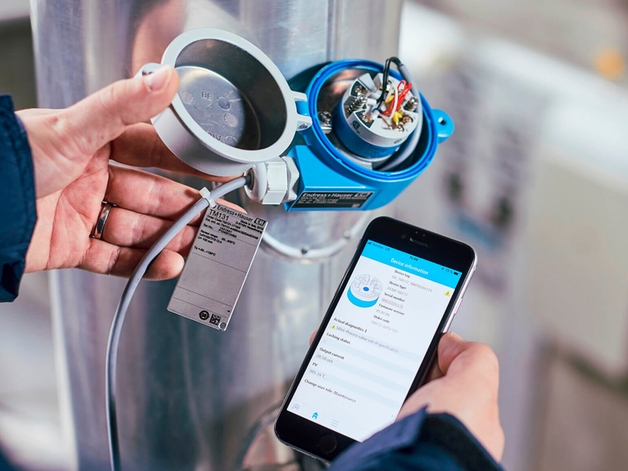
An Endress+Hauser device open with a man holding a smart device to conduct maintenance via Bluetooth

Explore secure wireless Bluetooth® connectivity

Learn how Bluetooth® connectivity enables safe, seamless wireless access to your field instruments with Endress+Hauser’s CPace, an industry‑proven security layer that keeps passwords protected and threats out.

IO-Link Teaser

Discover advanced Ethernet protocols

Explore how advanced Ethernet protocols enable high-speed Ethernet communication down to the field level, supporting network segmentation, secure architectures, and consistent security concepts from field devices to the control and enterprise layers. 

尾注

Learn more about cybersecurity