Calcia boosts clinker burning process with kiln inlet system
Gas analysis under harshest conditions, directly on rotary kilns
In 2020, Ciments Calcia, a subsidiary of Heidelberg Materials, presented the terms of a major investment program for several of its production sites. The program was in line with Heidelberg Materials' strategy to create a sustainable, low-carbon, high-performance business and even included a new 4,000-ton-per-day clinker production line at its Airvault cement plant improving handling and fuel efficiency, and process improvements at its cement production sites in Couvrot and Bussac-Forêt, France.

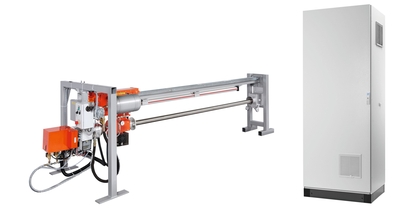
SCP3000 gas sampling probe for kiln inlets, installed at Calcia Couvrot

SCPS: 1. retraction unit; 2. mounting flange plate; 3. local control cabinet; 4. water/water cooler; 5. air/water cooler; 6. PLC cabinet; 7. instrument air pressure regulation; 9. MCS300P gas analyzer


The results
With extensive experience and a large installed base of process gas analysis systems from SICK at rotary kiln inlets, Calcia had once again decided to award SICK the contract to supply its Cement Probe System for projects to be carried out in France.
The conversion of the Calcia plant was carried out according to a very tight schedule. SICK adhered to the production shutdown schedule by prioritizing the system's production and coordinating technical approval and logistical efforts accordingly.
Installation and commissioning were managed efficiently with the help of the site maintenance staff. Since installation and commissioning, maintenance requests have been minimal and system availability has been above average.
This article was first published on www.sick.com on January 17th 2024. Since January 1st 2025 Endress+Hauser exclusively markets SICK’s gas analysis and flow measurement technology worldwide.

The current design of the system represents a major improvement. The system requires much less human intervention, just a weekly check. We are very satisfied with the current availability rate.
Calcia Couvrot
The cement industry is one of the most energy-intensive in the world, with energy accounting for up to 40% of production costs. That is why it is actively seeking alternative fuels to reduce its dependence on fossil fuels. Those are not only expensive but also increases greenhouse gas emissions. One of the most popular alternative fuels in the cement industry is waste-derived fuel, which includes materials such as wood chips, wastepaper, plastics, tires, and waste oil. These materials can be used to replace a large portion of fossil fuels in the production process, reducing costs while promoting decarbonization. Overall, the trend toward alternative fuels in the cement industry is driven by the need to reduce costs and emissions while remaining competitive in the global marketplace.
In the cement industry, it is well known that a high proportion of alternative fuels increases the risk of cyclone blockage, ring formation, and corrosion problems, which will lead to pressure losses, increased wear on kiln seals, incomplete combustion, and increased sulfur and chlorine volatilization. In addition, restricting the diameter of the kiln can lead to poor clinker granulation and increased gas velocity, which can increase dust formation and even cause local hot spots in the thermochemical process, damaging the refractory material and the outer shell of the kiln. The usual associated effects are frequent kiln shutdowns, reduced kiln availability, decreased productivity, and reduced clinker quality caused by deposit breakage. However, this phenomenon can be avoided by monitoring the gas composition in the thermochemical process and using this information for process control to maintain stable and optimized conditions. From the outset of the project, Calcia's managers attached great importance to choosing a process gas analysis system that was suited to the growing requirements for process control in modernized and future plants.
The customer requirement
The main tasks of process gas analyzers at the kiln inlet in cement plants are as follows:
Measuring the composition of the process gas in the rotating part of the kiln
Controlling the excess air (O2) ratio at the kiln furnace inlet
Controlling carbon monoxide (CO) concentration and combustion quality
Monitoring NO and NO2 concentrations for emissions and temperature control
Monitoring volatile sulfur compounds (SO2)
Transmitting information on the concentrations of the above-mentioned gases for burner control, fuel and raw material mixture adjustment and process gas control.
In addition to these features, other customers have benefited from the analysis system's ability to provide insight into the internal chlorine cycle by measuring the concentration of hydrogen chloride (HCl) in the kiln, helping plant operators reduce blockage issues caused by high chlorine volatility. Furthermore, this information is useful for limiting the volume flow of chlor bypass gas and thus keeping HCl emissions low.
Taking measurements in harsh environments with dust concentrations of up to 2,000 grams per cubic meter (g/m3) and temperatures approaching 1,400°C is a challenge, but the SCP3000 high-temperature gas sampling probe, with its water-cooled probe and highly effective self-cleaning function, is a reliable solution for gas sampling at the kiln inlet. Thanks to its special design and high-pressure backpurge system, probe clogging is prevented, even when used in kiln gases with high dust content and containing large amounts of chlorine and sulfur compounds. The optimized and reinforced gas inlet at probe is mounted at an angle opposite to the gas flow, minimizing the direct entry of dust and particles into the sampling system. This protects the highly corrosion-resistant probe tube, available in lengths from 2.5 to 4 meters, from abrasion and clogging.

The probe is cooled by an external water/water or air/water heat exchanger. The absence of moving mechanical parts in the gas path allows large quantities of gas to be collected, while eliminating the effects of thermal stress and blockages due to the limited contact surface inside the probe. The extracted gas is dedusted as it passes through the heated metal mesh dust filter installed at the Filter unit end of the probe. To reduce maintenance time, the filter, filter chamber, and probe tube are purged with pressurized air via integrated backpurge unit. The cleaning sequence can be started automatically or manually. The periodic rotation of the probe by +/-45° and the ability to move the probe 10 cm back and forth during operation, without interrupting the measurement, prevents deposits from sticking and baking onto the outer surface of the probe. As a result, the probe can be extracted at any time. To do this, the system has, in addition to an electric retraction unit, an additional pneumatic backup motor, which allows the probe to be removed from the kiln via a dust-resistant spindle drive, even in the event of a power failure. The mechanically or pneumatically controlled sealing flange prevents hot materials from flowing out of the kiln and protects people and machines in the outside area, while ensuring that no ambient air enters the interior of the furnace. The heated components of the system reduce the risk of thermal bridges and the associated problems of corrosive gas condensation. As a result, high system availability of over 95 % is guaranteed. The control unit and local control panel enable automated and manual operation of the device via an integrated touch screen.
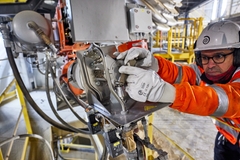
Manual inspection and cleaning of the SCP3000 dust filter is facilitated by access to the rear of the probe
Complete analyzer system solutions
Endress+Hauser is one of the few suppliers to offer complete gas extraction probe and analyzer solutions. In addition, it has the longest experience with gas analyzers at the inlet of cement kilns, based on Hot-wet measurement technology. With the MCS300P HW multi-component gas analyzer and its non-dispersive infrared (IR) photometer, cement manufacturers can measure up to 6 active gas components in the IR range, plus oxygen. For kiln inlet applications, the analysis system is normally configured to measure all combustion-related gas components such as O₂, CO, CH₄ (if natural gas is used), NO, CO₂, and process parameters such as SO₂, HCI, and NH₃. Thanks to hot-wet measurement technology, the gas path is fully heated from sample probe to gas analyzer. This means that the extracted gases are always above the dew point, reducing the risks associated with condensates, such as acid corrosion or pipe blockages. Since the gas sample is not cooled, even water-soluble components such as NH3, HCl, and SO2 can be measured with a single cell and without any gas treatment or calculation effort. In addition, SICK's hot-wet technology does not require additional gas coolers, special acid filters, water traps, or hydrogen peroxide dosing systems to remove corrosive SO2 from the process gas. This reduces maintenance efforts and consumables.
The combination of the SCP3000 high-temperature gas sampling probe and the MCS300P multi-component hot-wet gas analyzer makes it possible to meet the challenges of measuring gases at the kiln inlet in cement plants, regardless of high gas temperatures, high dust loads, or corrosive gases, without the need for complex and maintenance-intensive sample conditioning systems. The automated self-cleaning and self-adjusting capabilities of the analysis system ensure high availability and result in significantly lower operating costs than conventional systems based on cold-dry measurement technology, which where the gas sample preparation tend to be very complex and difficult to maintain. As a result, the operating costs of hot-wet measurement technology can be up to 40% lower than those of systems based on cold-dry measurement technology. The system is optimized for use with difficult fuels with high sulfur content (e.g., petroleum coke) and alternative fuels (tires, RDF, oils, wood chips, medical waste, etc.), making it reliable even when used in highly aggressive measurement atmospheres.

Monitoring Box is a digital solution for continuous monitoring of status of devices and plants, as well as the application itself.

The MCS300P HW multi-component gas analyzer and its non-dispersive infrared (IR) photometer
Digital solutions: know today what will happen tomorrow
In the future, Calcia plans to implement Endress+Hauser’s Condition Monitoring solution, a new digital service that increases the availability of the process gas analysis system at the kiln inlet. Monitoring Box is a digital solution for continuous monitoring of status of devices and plants, as well as the application itself. Vital data from connected devices is collected by the gateway, encrypted, and sent via mobile network, LAN, or Wi-Fi to a secure cloud host for further processing.
Condition-based maintenance monitors all vital parameters that indicate the health of the entire system – including the gas analyzer, the sampling system, and all auxiliary equipment such as the water-cooled gas extraction probe tube cooling system or the programmable logic controller.
Preventing unplanned breakdowns and downtime
This collected data can be viewed and evaluated in the Condition Monitoring web application. Significant changes in the condition of the device are monitored, enabling maintenance personnel to intervene in time and ensure system availability. In this way, the Condition Monitoring service improves equipment availability and reliability and helps prevent unplanned breakdowns and downtime. Optionally, connected devices can also be monitored by Endress+Hauser as part of a service contract.
This information makes it possible to identify problems before they occur. For operators, this translates into a longer system life cycle and a faster return on investment. In addition, this solution enables Endress+Hauser to optimize maintenance and ensure immediate troubleshooting, reducing travel costs and working hours for maintenance technicians.
These savings are directly passed on to the cement manufacturer. Thorough remote checks also improve the quality of data from analysis systems. These improvements increase overall maintenance efficiency and can extend the life cycle of machines.
A scalable solution
Thanks to the good relationship between SICK and Calcia, as well as many other members of the Heidelberg Materials Group worldwide, the Couvrot plant has been equipped with the SCPS3300 process gas analysis system at the kiln inlet, consisting of an SCP3000 gas extraction probe and an MCS300P hot-wet extractive multicomponent gas analyzer, the most suitable solution for this essential and demanding measurement application. The Beaucaire and Airvault sites also installed this solution.
联系信息
您对我们的产品组合感兴趣吗?想要谈谈您的实际应用吗?
相关产品组合



| FLEX产品选型 | 仪表技术性能 | 选型便捷程度 |
|---|---|---|
Fundamental选型 完美胜任基本测量任务 |
仪表技术性能
|
选型便捷程度
|
Lean选型 轻松应对关键工艺的测量挑战 |
仪表技术性能
|
选型便捷程度
|
Extended选型 创新技术助力工艺流程优化 |
仪表技术性能
|
选型便捷程度
|
Xpert选型 满足严苛工况的特殊测量要求 |
仪表技术性能
|
选型便捷程度
特殊选型 |