

The fourth treatment stage in operation
Reliable removal of micropollutants up to 80% at the Laichingen wastewater treatment plant
With the revision of the EU Urban Wastewater Treatment Directive (KARL), the fourth treatment stage for removing micropollutants is gaining importance for municipal wastewater treatment plants. While many operators face retrofitting challenges, the Laichingen plant has operated a fourth treatment stage since 2015. Experience shows that consistently high removal performance is achieved through appropriate process engineering, operational experience and continuous measurement technology.
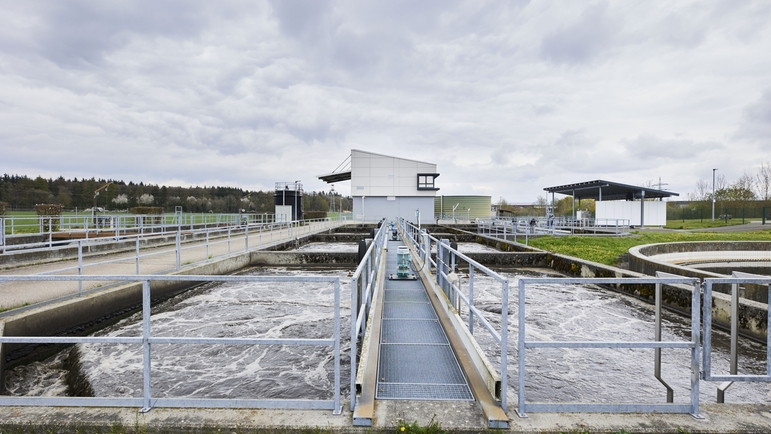
The Laichingen wastewater treatment plant is designed to serve approximately 35,000 population equivalents.
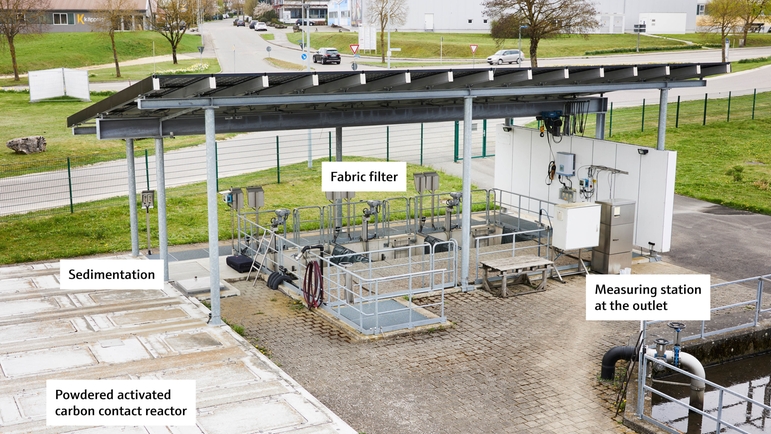
An overview of the fourth treatment stage in Laichingen


Results
Reliable measurement for monitoring the elimination of trace substances
Early detection of process changes allows for targeted countermeasures
Ability to adjust dosages, optimize contact times and stabilize solids separation
The challenge
Since there are no surface waters near the Laichingen wastewater treatment plant, the treated wastewater is discharged into the karst rock of the Swabian Alb via infiltration basins and quickly enters the groundwater. Due to its importance for the drinking water supply, protection was necessary at an early stage. Therefore, the plant introduced a fourth treatment stage in 2015 to remove trace contaminants. Fluctuating inflows and varying withdrawal rates place high demands on process control.
The realization
In Laichingen, the Ulm process, which uses powdered activated carbon, is employed. After biological treatment, the wastewater undergoes adsorptive treatment in a three-stage contact reactor cascade. Two systems operating in parallel sedimentation tanks follow. The partially loaded powdered activated carbon is discharged as excess carbon and returned to the denitrification tank. The final separation of solids and residual activated carbon is carried out using cloth filters.
Endress+Hauser's measurement technology plays a key role in ensuring that this process stage operates transparently and reliably. Relevant standard parameters are continuously recorded, enabling ongoing evaluation of the individual process steps. Sensors featuring Memosens technology, when used in conjunction with theLiquiline platform, provide robust and consistently stable measurement results over the long term.
In particular, the Delta-SAK measurement at the inlet and outlet of the fourth treatment stage provides a real-time view of the treatment’s performance. The measurement data collected makes it possible to identify process changes at an early stage and take targeted corrective action, for example, by adjusting dosages, optimizing contact times or stabilizing solids separation. This ensures that the required reduction in micropollutants by more than 80 percent is maintained over the long term.
联系信息
您对我们的产品组合感兴趣吗?想要谈谈您的实际应用吗?

