Understanding how the different ultrasonic sensors work
Article相关资源03.12.2024
简述
Ultrasonic flow measurement uses ultrasound to measure flow rates through three methods: transit time differential, Doppler shift, and cross-correlation. The transit time method is the most accurate and widely used, applicable to liquids, gases, cryogenic, and high-temperature applications.
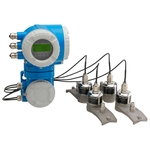
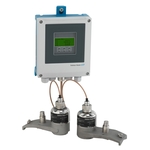
Ultrasonic sensors come in three types: clamp-on, insertion, and inline. Clamp-on sensors measure flow from outside the pipe, insertion sensors are in direct contact with the fluid, and inline sensors are pre-installed in measuring tubes for high accuracy.
目录目录
Ultrasonic flow measurement
The field of ultrasonic measurement covers a variety of models and types of flowmeters. The term “ultrasonic” does not unequivocally define the type of flowmeters. “Ultrasonic” merely indicates that the flow rate is measured using ultrasound. Actual flow is measured by either of three fundamentally different methods:
Transit time differential method (time-of-flight)
Doppler method
Cross-correlation method
The most applied and most accurate method is transit time differential (time of flight). It can be applied to liquid, gas, cryogenic (including LNG) and in high temperature applications.
We offer a complete portfolio for versatile and economical flow measurement of gases and liquids up to a nominal diameter DN 4000. Click here to see all ultrasonic flowmeters.
At the end of the course you will know about the features of the PROFINET technology and the PA profiles, network design of 100BaseTX and Ethernet-APL.



%20with%20flange%20connections%20for%20accurate%20measurement%20of%20natural%20and%20process%20gas%20-%20PP01.jpg "超声波流量计Proline Prosonic Flow G 300(9G3B)产品图:坚固耐用的气体测量专家")